We Don't Track What You Spent. We Plan What You Won't Have to Think About.
Tracking every transaction is why most budgeting apps get abandoned within weeks. Sovereign doesn't ask you to.
A randomized study of over 9,000 budgeting-app users, run by the behavioral-economics research firm Irrational Labs, found something worth sitting with: adding category-level tracking on top of a simple overall budget produced no reduction in spending — average weekly spending came out nearly identical whether people tracked one number or tracked every category. More strikingly, spending in a category that had its own specific budget actually ran about $30 higher than spending in categories left untracked. The thing most budgeting apps ask you to do every day turns out not to be the thing that actually helps.
Why logging every purchase backfires
Transaction-by-transaction tracking asks for something most people can't sustain: perfect, ongoing attention to every purchase, forever. The first week is usually eye-opening. By week three, life happens, a few days go unlogged, and the whole system starts to feel like something to catch up on rather than something that's helping. That's the moment most people quietly stop — not because they failed, but because the system demanded more consistency than anyone reasonably has.
There's a second cost that matters even more: guilt. When every purchase gets measured against a category limit in real time, a single overspent week starts to feel like a failure, even when the month, or the quarter, is completely fine. That's backwards. One month running high on dining and low on entertainment isn't a crisis — it's just a detail. The system is built to absorb exactly that kind of normal variation without anyone needing to feel bad about it.
What Sovereign does instead
Each Bucket is a guardrail set in advance — a healthy range, sourced from real data for your income level — not a running tally that needs to be checked daily. The whole point of setting the range ahead of time is that day-to-day spending doesn't need constant supervision. If groceries run a bit high one month and entertainment runs low, that's not a driver of anything. It doesn't move the Sovereignty Meter. It's not a mistake to feel guilty about. It's just one month, inside a system built to handle normal variation without anyone needing to notice in real time.
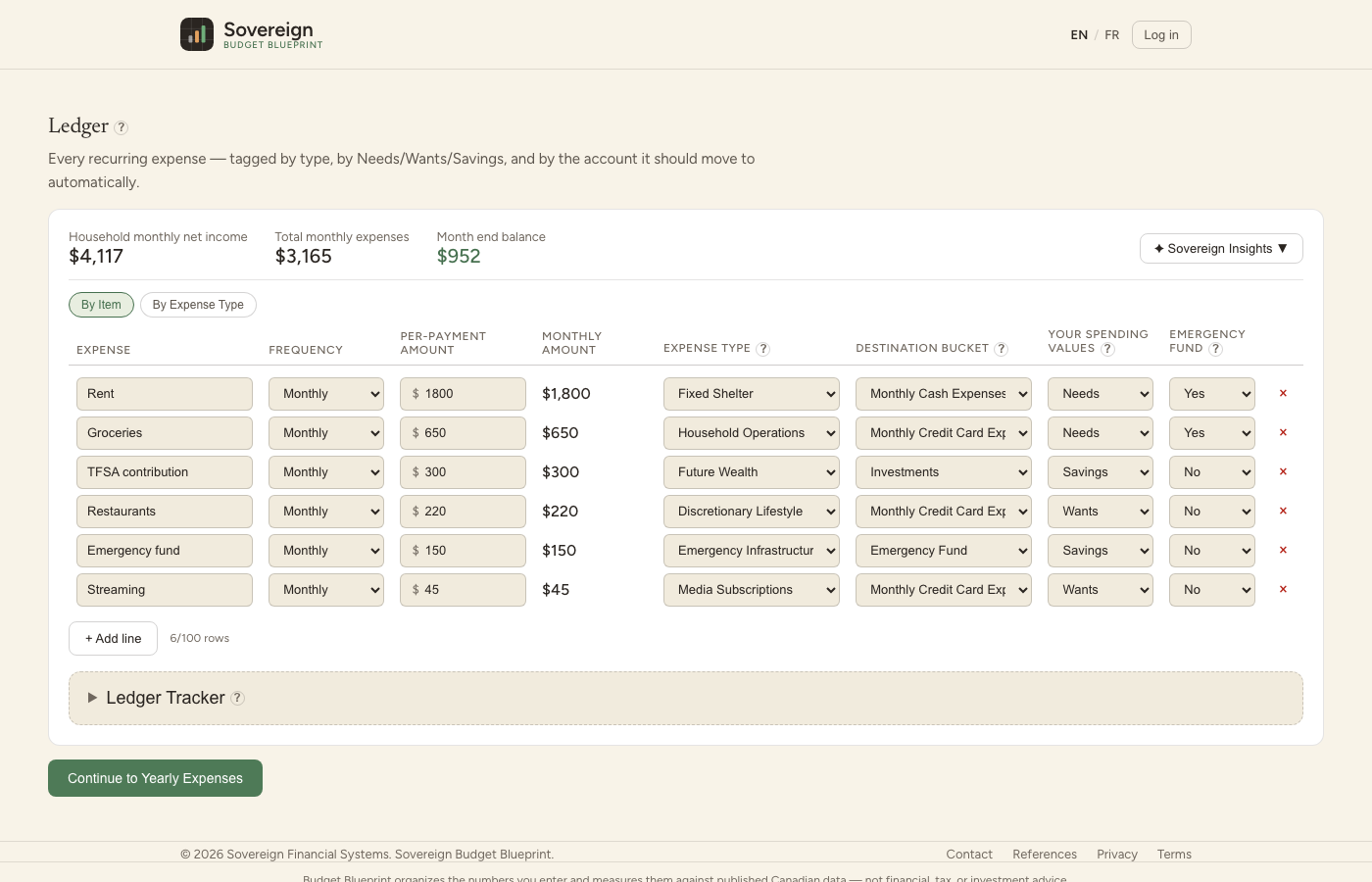
If you specifically want more than that — a real, item-by-item record of what actually happened each month against what you budgeted — that's here too. An optional Ledger Tracker exists for exactly that, off by default and built because real users asked for it directly. It's for your own reference; it doesn't feed the Sovereignty Meter, and using it was never the point of the system working. The guardrails above do that on their own.
This isn't the same as never looking. It just means looking periodically, on purpose, rather than constantly, out of anxiety. That's a real, different practice — worth its own explanation, which is exactly what the next piece covers: when to actually sit down and update the Ledger, and how to do it without it becoming a chore.
— The Sovereign Team