The Bill That Wasn't a Surprise, Except It Was
Property tax and insurance renewals show up on the same date every year and still catch people off guard. Ties to Move 3 — Allocate & Automate, where yearly bills get their own Bucket.
A U.S. Federal Reserve survey found that 28% of adults struggled to pay their bills in the month before they were asked, and 16% didn't pay at least one in full. The striking part isn't that money runs short sometimes — it's how often the bill that causes it isn't actually a surprise. Property tax, car insurance, an annual subscription, a professional licensing renewal — these show up on the same date every year. The amount is usually knowable in advance. And they still land like an ambush, because a monthly budget only accounts for monthly bills, and these aren't monthly.
Two different problems that feel the same
It's worth separating two things that get lumped together as "unexpected expenses," because they need different responses:
Non-monthly expenses are real, expected costs that just don't come due every month — property tax, car registration, an annual insurance premium, a professional membership renewal. The amount and the date are usually predictable well in advance, often printed on last year's bill. These aren't emergencies. They're scheduling problems.
True emergencies are the ones nobody can predict — a job loss, a burst pipe, an urgent medical cost. These need an emergency fund, not a schedule (that's a separate topic — see the piece on protecting a runway).
Mixing the two together is exactly what causes the feeling of being blindsided by something that was actually printed on a bill a year in advance.
Why "just budget monthly" doesn't catch this
A typical monthly budget checks whether income covers this month's expenses. That works fine until a bill lands that wasn't part of "this month" in any of the eleven months before it. The bill isn't unaffordable — it just wasn't accounted for anywhere until the moment it arrived, which is the worst possible time to discover a $1,400 shortfall.
The fix isn't complicated: total up everything that bills yearly, quarterly, or otherwise off the monthly cycle, divide by twelve, and set that amount aside every month whether or not anything is due. When the actual bill shows up, the money is already there. It stops being a crisis and becomes paperwork.
There's a second layer worth knowing, too: these bills usually aren't spread evenly across the year. Property tax often lands in specific installments, insurance renewals cluster around certain months, back-to-school costs hit in late summer. A household can be fully funded on a yearly-total basis and still come up short in a specific heavy month if the timing wasn't mapped — which is why knowing not just how much but when matters just as much.
What this actually looks like in practice
Every recurring expense gets tagged with the month or months it's actually due. Once that's mapped, it becomes visible whether the year is front-loaded, back-loaded, or reasonably even — and if six months are carrying most of the load, there's still time to shift something flexible into a lighter month before it becomes a problem, instead of finding out the hard way in month seven.
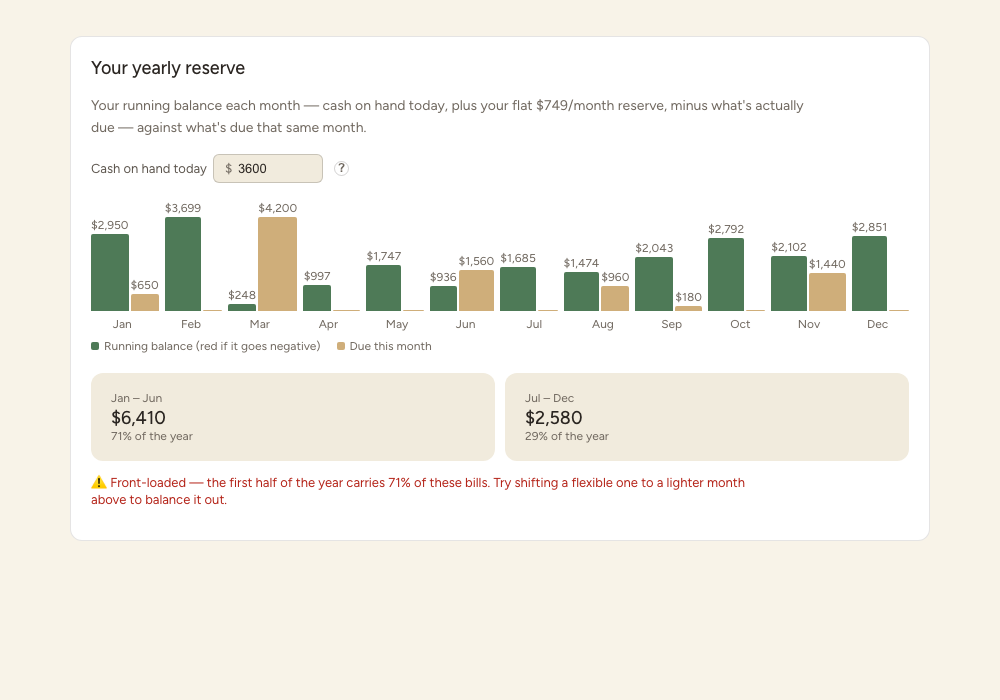
This is why "give every dollar a Bucket" includes a Yearly Expenses bucket specifically, separate from regular monthly cash flow — these predictable, non-monthly bills need their own reserve, funded monthly, so the due date itself is a non-event.
— The Sovereign Team